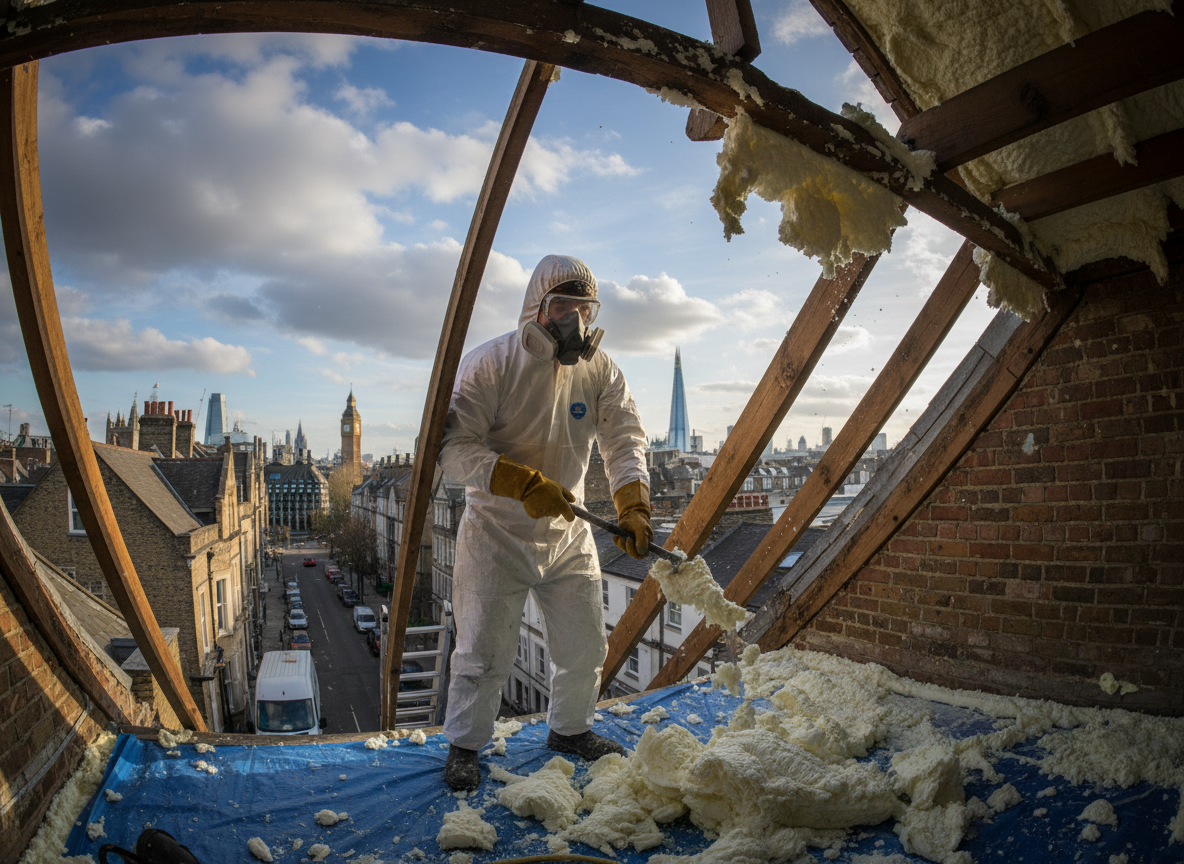
Mortgage lenders in the UK frequently decline finance on properties where spray foam has been applied directly to roof tiles or rafters, especially in pre-1950 stock common across Islington and N7. The foam traps moisture against the tiles, accelerates timber decay, and blocks the ventilation paths required by current building regulations. Removal must be carried out without damaging historic lath-and-plaster ceilings or original roof timbers that are standard in Victorian and Edwardian terraces throughout north London.
In the London climate, persistent damp and driving rain make the job more delicate than in drier regions. Foam that has been in place for several winters often bonds tightly to clay tiles and felt, requiring controlled mechanical scraping followed by solvent treatment on stubborn residue. Access is frequently restricted by narrow loft hatches and low-pitched roofs typical of N7 terraces, so dust containment and debris removal through internal stairs become critical to avoid contaminating living spaces below.
Edge cases include properties where the foam was sprayed over existing mineral wool or where electrical cables have been buried inside the insulation. These installations demand extra time to trace and protect wiring before any material is disturbed. Once the foam is cleared, the roof void must be left with clear eaves-to-ridge airflow so the property can pass the lender’s valuation inspection without further conditions.
Technician insight
In London, the thing that catches most people out with mortgage lender spray foam removal is how quickly foam bonds to the underside of clay tiles in unventilated Victorian roofs around Islington and N7; once winter damp has set in, scraping leaves residue that still fails the surveyor unless you follow up with a solvent wash.
N7 Terrace Mortgage Hold
Homeowner in a 1890s Islington terrace could not proceed with purchase because spray foam covered the rafters. Inspection showed foam had blocked all eaves vents and trapped moisture against the tiles. We stripped the material, restored clear airflow paths and supplied the required clearance report; the lender released the mortgage within ten days.
How it works
- 1
Initial Loft Inspection
Assess foam depth, bonding points, electrical runs and access routes in the specific property.
- 2
Containment Setup
Install dust barriers and negative-air extraction to protect the rest of the London terrace house.
- 3
Foam Removal
Mechanically strip and treat residue while preserving original roof timbers and ventilation paths.
- 4
Clearance and Verification
Remove all debris, confirm airflow at eaves and ridge, then supply documentation for the mortgage lender.
Pricing
Price varies with loft size, foam thickness and access difficulty in period properties.