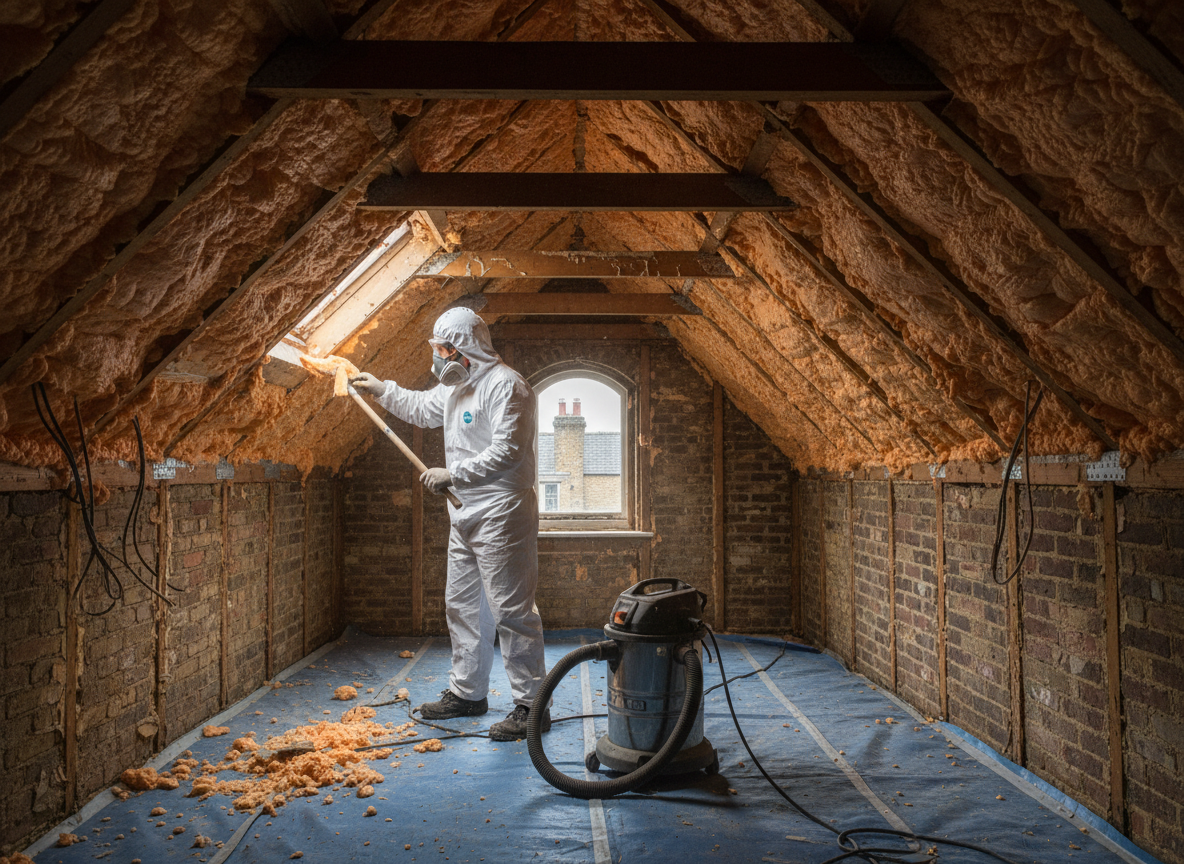
Closed cell spray foam bonds tightly to timber joists and slate undersides common in N7 and Islington Victorian terraces. Once installed it often seals roof spaces that were never meant to be airtight, leading to condensation on rafters during London's frequent wet winters. Removal requires cutting the foam into manageable sections while protecting original lath and plaster ceilings below, especially in properties built before 1910 where the timber is brittle and the roof pitch is steep.
Homeowners in Camden and Holloway frequently discover the foam has wicked moisture into wall cavities after heavy autumn rain. The material does not release water easily, so sections must be removed in stages with constant checks for hidden damp on brickwork. Access is usually through small loft hatches or by lifting floorboards in top-floor rooms, and care is taken not to disturb shared chimney stacks that run between neighbouring terraces.
After the bulk of the foam is cleared, residual adhesive on joists is scraped by hand because mechanical grinding risks damaging the thin historic timbers. Ventilation is then restored using traditional methods such as ridge vents and eaves gaps that suit the original roof construction. In properties near the Regent's Canal the higher water table means extra attention is paid to any foam that reached the lower wall plates.
Technician insight
In London the thing that catches most people out with closed cell spray foam removal is how the foam has crept behind the fascia boards on Victorian roofs in Islington and Holloway. Once winter temperatures drop and the heating goes on, the trapped moisture starts showing as black mould on the top-floor ceilings, and by then the foam is bonded so hard to the thin rafters that any rushed removal risks splitting the timber.
Holloway Terrace Loft
Closed cell foam had been sprayed across the entire loft of a 1890s terrace, sealing the eaves. We found condensation soaking the original rafters and mould on the bedroom ceiling below. The foam was sectioned and lifted out carefully, adhesive scraped from the joists, and the eaves vents reopened to restore airflow.
How it works
- 1
Site Inspection
We examine the loft or wall cavities in the specific London property, noting roof type, timber condition and any shared party walls.
- 2
Containment Setup
Dust sheets and extraction equipment are positioned to protect living spaces below, particularly important in multi-storey terraces.
- 3
Foam Sectioning and Removal
The closed cell material is cut into blocks and lifted out without disturbing original roof timbers or insulation layers already present.
- 4
Surface Cleaning and Ventilation Check
Adhesive residue is removed and airflow paths are reopened to match the building's original design.
Pricing
Price depends on access difficulty, depth of foam and whether work is needed in multiple rooms or shared walls.