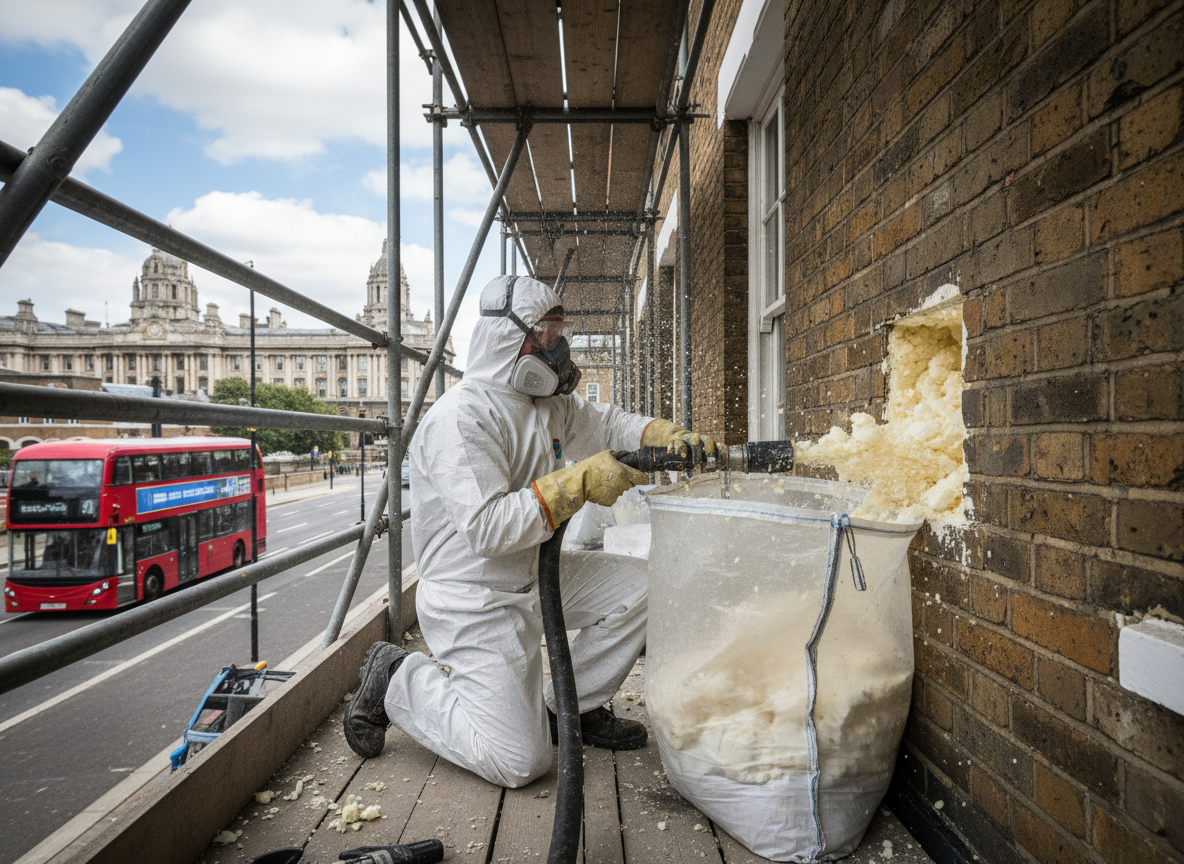
Cavity wall spray foam removal in London often involves properties built between the 1920s and 1970s where urea formaldehyde or polyurethane foam was injected into brick cavities. In neighborhoods like Islington and Hackney, many terraced houses have narrow 50-75mm cavities that trap moisture once the foam degrades, leading to penetrating damp on internal walls during the city's frequent winter rainfall. Removal requires careful drilling patterns to avoid damaging the outer leaf while extracting saturated material that has bonded to mortar joints.
London's clay-heavy soil and high water table exacerbate problems when foam fails, as water sits against the inner wall instead of draining. Technicians working in Camden or Haringey routinely encounter cases where foam has expanded unevenly around electrical cables and pipework, requiring section-by-section extraction to prevent further damage. Proper ventilation and debris containment are essential because removed foam particles can become airborne in confined loft spaces common to these Victorian and Edwardian conversions.
Edge cases include party-wall properties where foam migration has occurred across boundaries, demanding coordinated access and dust control to satisfy both owners. In areas with rendered exteriors, such as parts of Finsbury Park, the removal process must preserve the render integrity while clearing the cavity completely to allow proper ventilation and drying before any re-insulation.
Regulation notes for Greater London focus on waste classification of removed foam as construction and demolition waste, requiring licensed disposal rather than general landfill. Homeowners in N7 and nearby postcodes should expect the cavity to be left clear and ventilated rather than immediately re-filled, allowing assessment of any underlying damp issues first.
Technician insight
In London, the thing that catches most people out with Cavity wall spray foam removal is how Victorian terraces in Islington and nearby streets have shared walls and narrow cavities that let moisture from winter rain migrate sideways once the foam breaks down.
Islington Terrace Damp Investigation
Homeowner reported persistent damp on a first-floor party wall in an N7 Victorian terrace. Inspection found degraded spray foam holding water against the inner leaf. We extracted the foam through controlled external drill points, cleared debris and left vents in place. The wall dried over the following week with no further migration into the adjacent property.
How it works
- 1
Initial Cavity Inspection
Survey the property to map cavity depth, foam type and moisture levels using borescope access points in external walls.
- 2
Targeted Drilling and Extraction
Drill strategic entry points and use specialist vacuum equipment to remove foam without compromising brickwork or shared walls.
- 3
Debris Clearance and Ventilation
Clear residual particles, install temporary vents and monitor drying over several days before any further works.
- 4
Final Cavity Check
Re-inspect with camera to confirm the cavity is clear and document condition for the homeowner.
Pricing
Pricing varies by property size, cavity condition and access constraints typical of London terraces; site visit required for accurate assessment.